Tuesday, 19 August 2014

Boko Haram Crisis: Nigerian Soldiers 'mutiny over weapons'

http://news.bbcimg.co.uk/media/images/77036000/jpg/_77036470_77034153.jpg
The defence forces have not been able to crush the militants who have moved to bases in the bush


A group of soldiers in north-eastern Nigeria is refusing to fight Islamist Boko Haram militants until they receive better equipment, one of the mutineers has told the BBC.

The soldier, who requested anonymity, said at least 40 of his colleagues would refuse orders to deploy.

The military has not commented on the reported mutiny or the demands.

A state of emergency that was declared in three north-eastern states last year has failed to curb the insurgency.

Boko Haram is fighting to create an Islamic state in Nigeria - and has stepped up its attacks after being pushed out of its bases in Maiduguri, the capital of Borno state, targeting towns and villages in deadly raids.
'Sacrificing soldiers'
"Soldiers are dying like fowl," the soldier, who said he and his colleagues were just outside Maiduguri, told the BBC Hausa service.

"The Nigerian army is not ready to fight Boko Haram," he said, explaining that soldiers were not being given enough weapons and ammunition to take them on.

"Boko Haram are inside the bush, everywhere," he said "They [senior commanders] are sacrificing soldiers," he said.

Who are Boko Haram?

A screen-grab taken on 12 May 2014, from a video released by Nigerian Islamist extremist group Boko Haram Boko Haram leader Abubakar Shekau has been designated a terrorist by the US government
  • Founded in 2002
  • Initially focused on opposing Western education - Boko Haram means "Western education is forbidden" in the Hausa language
  • Launched military operations in 2009 to create an Islamic state
  • Thousands killed, mostly in north-eastern Nigeria - but also attacks on police and UN headquarters in capital, Abuja
  • Some three million people affected
  • Declared terrorist group by US in 2013

Jonathan To Disburse N220bn MSME Fund Today

President Goodluck Jonathan


Barring any last minute change, President Goodluck Jonathan will today (Tuesday) commence the disbursement of the N220bn Micro, Small and Medium Enterprises Development Fund.

The Governor, Central Bank of Nigeria, Mr. Godwin Emefiele, disclosed this on Monday in Abuja, while speaking at the 8th annual MSME finance conference.

The conference with theme, ‘MSME financing in Nigeria: Past, present and future’, was conceptualised to 
look at the MSME finance sub-sector from a holistic perspective.

Sixty per cent of the fund has been earmarked for providing financial services to women in order to address their peculiar financial exclusion circumstances.

According to the guidelines of the fund, each state of the federation will be able to access the sum of N2bn, which will be administered to beneficiaries at an interest rate of nine per cent.

Already, the central bank has signed Memoranda of Understanding with the governors of Delta, Akwa Ibom, Osun, Oyo, Bayelsa, Gombe, Zamfara, Enugu, Ondo and Benue states to access the fund.

Two per cent of the fund will also be made available for economically active physically challenged entrepreneurs.

Speaking at the event, Emefiele said since the economy in recent times had been driven by growth in the non-oil sector, there was a need to provide affordable and efficient financial services for the MSMEs.

He said, “In the last seven years, our economy has expanded by seven per cent; and in the first quarter of 2014, the real Gross Domestic Product grew by 6.2 per cent, mainly driven by an 8.2 per cent growth in the non-oil sector.

“However, sustaining the developmental strides with inclusive growth will depend largely on the provision of affordable and efficient financial services for the MSMEs, particularly the micro enterprises, which account for about 90 per cent of the MSMEs in Nigeria.

“It is imperative that this segment of the financial system be strengthened in order to forestall the social adverse consequences of financial exclusion.”

Emefiele said access to finance had a multiplier effect on the economy as it would have the much needed catalytic effect on job creation and poverty reduction.

He added, “It is in realisation of this fact that the central bank launched the N220bn MSME fund to provide financial resources to entrepreneurs across the country through the participating financial institutions.

“I am, therefore, very pleased that Mr. President has agreed to start the disbursement of this fund tomorrow (Tuesday).”

Emefiele said this year’s conference would help to consolidate efforts towards the empowerment of entrepreneurs, while formulating policies that would help to address the challenges of that sector of the economy.

The governor said the central bank had put in place modalities that would help ensure that only qualified small business owners would benefit from the fund.

He said, “This is not a grant or sharing of money; this is an opportunity or avenue for what we call micro and small-scale enterprises to access finance. The intension here is to make it possible for you to access finance and 60 per cent of the fund will be going to women as addressed in the guidelines released.

“Fifty per cent will go to the SMEs; 9.75 per cent of the money will be used for capacity building to build capacity for understanding business and understanding how you can be an entrepreneur, and being able to say ‘I own a business’.”

He warned that those compiling fake names and mobile numbers to access the fund would not succeed, adding that the biometrics of beneficiaries would be taken.

Emefiele noted that names of defaulters would be put in the data base and no institution would lend money to such individuals.

US Air Power Aiding Iraq In Fight Against Militants


Backed by a series of U.S. airstrikes, Iraq's military is fighting back against Islamic militants who have seized large swathes of land across the north and west of the country into Syria declaring it a "caliphate."

On Tuesday, Iraqi forces halted an advance designed to retake the hometown of executed former dictator Saddam Hussein after facing fierce resistance from Islamic State militants, officers in the operations room told Reuters.

Iraqi forces came under heavy machinegun and mortar fire south of Tikrit, while to the west landmines and snipers undermined efforts to get closer to a town they have tried to retake several times, said the officers.

Resident of central Tikrit said by telephone Islamic State fighters were firmly in control of their positions and were running patrols along main streets.
Officials said the offensive began early Tuesday.

Success in Mosul

Monday, the U.S. military helped Iraqi and Kurd forces recapture a strategic dam in the north from the Sunni extremists.

U.S. President Barack Obama said if the militants had breached the Mosul Dam, it would have brought "catastrophic" floods to northern Iraq, killing thousands.

Obama said the U.S. is seeing important progress in Iraq, helping push back the militants and providing arms and aid to Kurdish and Iraqi forces.

In Geneva, the United Nations refugee agency said it is preparing a massive operation to provide aid to
500,000 people displaced in northern Iraq.

The agency said tents and other supplies will be airlifted to Irbil, the capital of the Kurdish autonomous region, starting Wednesday.

The U.N. estimates that 1.2 million Iraqis have been displaced by fighting this year, since the Islamic State group took over large parts of northwestern Iraq.

Click to enlarge
The Pentagon said it carried out 15 more airstrikes Monday against Islamic State militants near the dam, destroying more of their fighting positions and weapons.

The Mosul Dam is crucial to northern Iraq, providing electricity and irrigation for much of the region.


The United States first launched airstrikes earlier this month against the insurgents, in part to prevent the killing of thousands of minority Yazidis stranded on Mount Sinjar in northern Iraq.

Karzai Urges End To Afghan Election Stalemate

Afghan President Hamid Karzai, center, calls for resolution in presidential election. He's flanked by candidates Ashraf Ghani, left, and Abdullah Abdullah in Kabul Aug. 19, 2014.
Afghan President Hamid Karzai, center, calls for resolution in presidential election. He's flanked by candidates Ashraf Ghani, left, and Abdullah Abdullah in Kabul
Afghan President Hamid Karzai marked the 95th anniversary of Afghanistan's independence Tuesday with an appeal to end the nation's two-month election dispute over who will succeed him.

Standing alongside candidates Abdullah Abdullah and Ashraf Ghani, who have failed to agree on who won the election, Karzai said Afghanistan needs an inclusive government.

He said the nation is waiting "impatiently" for the final result. Allegations of fraud have come from both sides.
Karzai said he hopes a new president can be sworn in by August 25, a goal some see as overly optimistic.

The 8 million votes cast during the June 14 run-off between the two candidates are being audited in a deal mediated by U.S. Secretary of State John Kerry.

Taliban fight continues

As the stalemate drags on, the country's fight against the Taliban continues.

General Abdul Hakeen, the police chief of Logar province south of Kabul, told VOA’s Dari Radio on Tuesday that Afghan security forces had repelled a "large-scale Taliban offensive" in Azra District. He said at least 17 Taliban fighters were killed in the firefight, as well as one Afghan police officer.

The Reuters news agency reported up to 700 Taliban insurgents were taking part in the battle.

Ebola Kills Another 84 In West Africa

Health workers with buckets, as part of their Ebola virus prevention protective gear, at an Ebola treatment center in the city of Monrovia, Liberia, Aug. 18, 2014.
Health workers with buckets, as part of their Ebola virus prevention protective gear, at an Ebola treatment center in the city of Monrovia, Liberia.

The World Health Organization says another 84 people have died in West Africa as a result of the Ebola virus, bringing the death toll from the epidemic to 1,229.

The U.N. health agency announced Tuesday the number of confirmed and likely infections has risen to 2,240, including 113 new cases reported late last week.

The majority of the new deaths were in Liberia, where authorities are struggling to contain the virus.  On Sunday, at least 17 suspected Ebola patients fled an isolation center in Monrovia when armed men attacked and looted the facility.

Reuters news agency quotes a government spokesman as saying all 17 have been located and transferred to another clinic.
Click to enlarge
Medical aid group Doctors Without Borders says it has opened a new 120-bed Ebola management facility in Monrovia.  Much of the city's established health care system has shut down due to fears of Ebola among doctors and staff.

The disease is transmitted through direct contact with the blood or bodily fluids of an infected person.

The WHO noted that governments have set up quarantine zones in parts of Guinea, Liberia and Sierra Leone.

 The agency said it is working with the U.N. World Food Program to distribute food to about one million people living in those areas.

The U.N. health organization is also urging authorities in the affected countries to screen all passengers leaving airports, seaports and major border crossings for signs of the virus. 

Leaders Of EU, Russia, Ukraine To Meet In Minsk


FILE - Ukrainian President Petro Poroshenko
Ukrainian President Petro Poroshenko

The leaders of the European Union, Ukraine and Russia will meet in Minsk, Belarus, on August 26 to discuss energy security and the conflict in east Ukraine, Ukraine's President Petro Poroshenko said on Tuesday.

“The high-level meeting… [will] discuss issues related to the implementation of the Association Agreement between Ukraine and the EU, energy security and the stabilizing of the situation in the Donbas,” a statement on his website said. Donbas refers to Ukraine’s industrial east.

The meeting will also include the leaders of Kazakhstan and Belarus, who are part of a Russian-led Customs Union, it said.
The Kremlin said Russian President Vladimir Putin would join President Poroshenko at the Minsk meeting.

The EU delegation wil reportedly be led by the bloc's foreign policy chief, Catherine Ashton.

Poroshenko will then visit Brussels on August 30, the statement on his website said.

Bodies of 17 civilians recovered

The Ukrainian government says it has recovered the bodies of 17 civilians who were in a convoy of vehicles fleeing Luhansk when they were struck by a missile Monday.
Security and Defense Council spokesman Andriy Lysenko said Tuesday efforts to recover more bodies have been suspended due to fighting in the war-torn eastern area.
Click to enlarge
Lysenko announced at a news conference in Kyiv late Monday that separatists had fired Grad rockets, supplied by Russia, at a convoy of civilians fleeing the besieged city of Luhansk.
Speaking Tuesday, he said women and children were among the dead but added it was impossible to ascertain how many may have died in the attack. Other Ukrainian officials said some of the dead were burned to death in their vehicles.
The separatists denied allegations they were behind the attack, although insurgent leaders don’t deny some kind of rocket attack took place Monday that led to civilian deaths.
But they accused Ukrainian government forces of being behind the deadly strike. They said Ukrainian forces are bombing roads.

US condemns shelling

The U.S. State Department condemned the shelling of the convoy but said it couldn't confirm who was responsible.
The death toll has risen since April, when the Ukrainian army supported by volunteer battalions launched a counter-insurgency operation  to try to wrest cities and towns seized by separatists in Donetsk and Luhansk regions.
Last week, the United Nations nearly doubled its estimate of the number of people killed in eastern Ukrainian conflict to 2,086 as of August 10.
Ukrainian soldiers load a Grad missile during fighting with pro-Russian separatists close to Luhansk, eastern Ukraine, Aug. 18, 2014.Ukrainian soldiers load a Grad missile during fighting with pro-Russian separatists close to Luhansk, eastern Ukraine, Aug. 18, 2014.

Half are likely civilians, officials told VOA. They include 298 who died in the downing of a Malaysian commercial jet last month by a missile that Western governments have said was fired by rebels and supplied by Russia.
The U.N. blamed most civilian casualties on the separatists.
Some civilians in Donetsk and Luhansk - it isn’t clear how many - have died when Grad rockets struck their homes.
The rumble of rocket and mortar exchanges is heard every day in both cities with episodic bombardments, most often at night or around dawn.


Trading blame

Ukrainian officials say they are only fighting a ground war and are not firing artillery towards residential areas. They claimed rebels are responsible for the bombings, conducting them for propaganda purposes to place the blame on Kyiv.
The accuracy of the claims of either side are difficult to verify.
VOA has heard Grads being launched from behind government lines and has been told by Ukrainian soldiers that insurgent mortar and rocket fire is answered with their own artillery.
Equally, VOA has traveled down roads in and out of Donetsk that have come under mortar fire from rebel positions.
Combatants from both sides are operating in residential areas, mixing with civilians, and the ordnance being used is old and far from accurate.

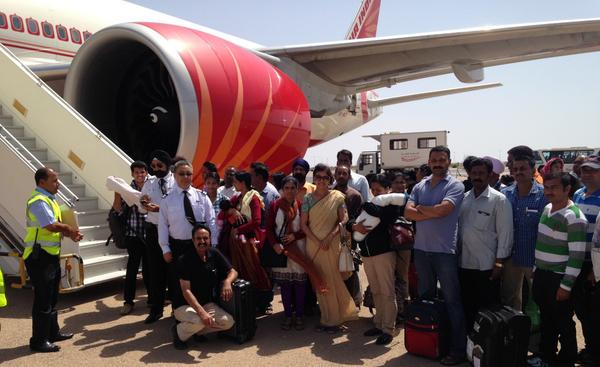
216 More Indians Return From Libya


Another batch of 216 Indians returned from Libya via Djerba today, taking the total number of Indians evacuated from the strife-torn country to 2,750, the Spokesperson in the External Affairs Ministry said, adding that the process of getting Indians out was continuing. Out of 2,750 Indians, private companies facilitated departure of 450 Indian workers employed with them.

View image on Twitter

Apart from taking a slew of measures to facilitate the departure of Indians in Libya, which is witnessing stepped up violence, the Ministry has issued a number of advisories asking Indians to leave the conflict-hit country and not to travel there.

Prior to the uprising in Libya, the number of Indians there was estimated to be more than 18,000. The Indian professionals were mainly employed in hospitals and other teaching institutions whereas a major part of manpower was engaged in construction projects. During the course of the revolution, most of them were evacuated to India in February-March 2011.

Few hundred Indians continued to serve in Libya even during the revolution period. Gradually, more Indians have returned to Libya and there were about 4,500 registered Indians before the outbreak of fresh violence there. An estimated unregistered 1000 or more Indians are also expected to be there, according to officials.